When I checked it in read memory mode, a diagnostic code “22” appeared.
I decided to perform a D-check to see if the problem persists or has already been resolved.
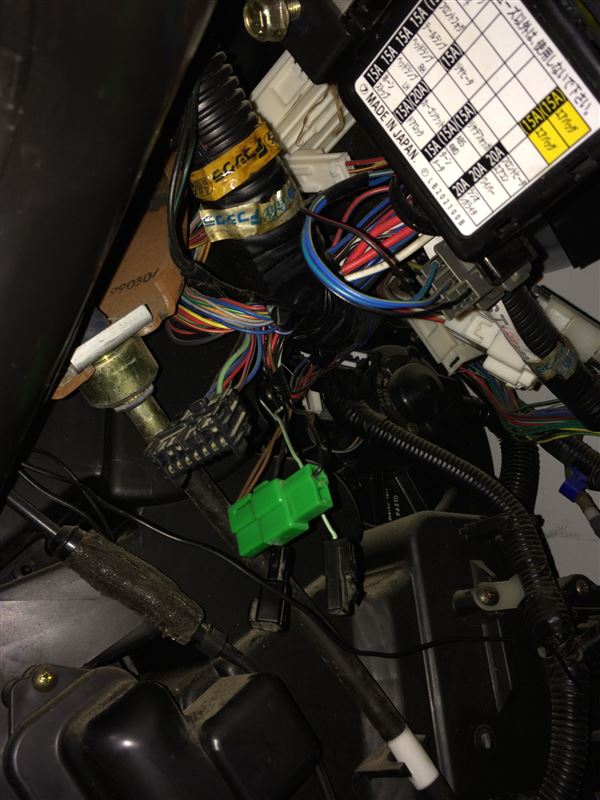
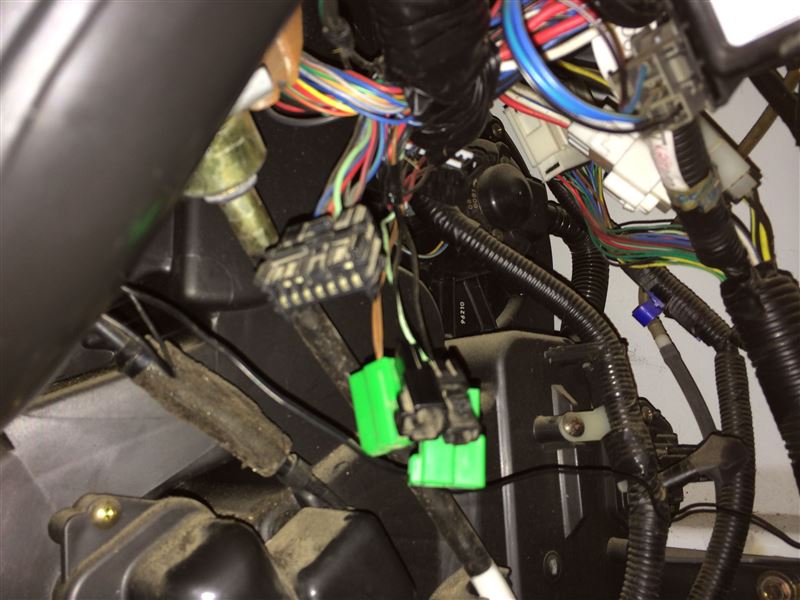
Apparently, connecting the green test coupler (2-pole) will enter D-check mode.
I’ve written the procedure below to record it.
D-check Procedure
- Warm up the engine sufficiently.
- Turn the ignition key switch to the OFF position.
- Connect the green test coupler (2-pole).
- Turn the ignition key switch to the ON position. (The engine will not start.)
- Check that the “POWER TRAIN” lamp is lit.
- Fuel Pump Inspection:
Check that the fuel pump is operating intermittently. You can also check by touching the fuel hose in the engine compartment and feeling the vibrations.
If the check fails, inspect the fuel pump circuit.
- Radiator Fan Inspection:
Check that the radiator fan operates intermittently.
If not, check the radiator fan circuit. - Throttle Sensor Signal Input
Slowly press the accelerator pedal fully and then release it. - Engine Start
For automatic transmission vehicles, start the engine in P range. - Vehicle Speed Sensor Signal Input
Drive at 30 km/h or faster. - Turn the heater blower switch on and off.
- Turn the headlights on and off.
- For automatic transmission vehicles, turn the “POWER MODE” switch on and off.
- Depress the brake pedal and slowly shift through all gears.
- O2 Sensor Signal Input
Maintain engine speed between 2000 and 3000 rpm for at least one minute to activate the O2 sensor. - Check that the “POWER TRAIN” lamp is on.
If the system is operating normally, it will flash at regular intervals.
If there is an abnormality, the number of flashes will indicate a diagnostic code.
If multiple diagnostic codes are displayed, diagnose each one one by one, starting with the lowest number, and repair one (after repairing it, run a D-check to confirm that the diagnostic code has disappeared). After completing this, if another code appears in the D-check, repair that code.
After performing the above steps, diagnostic code “22” was displayed.
It seems that there is something wrong with the knock sensor system after all.
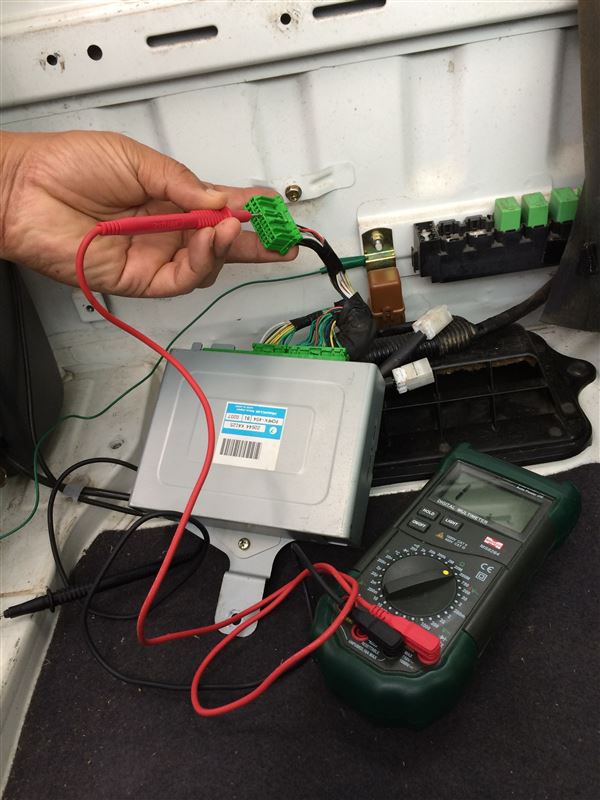
Perhaps the coupler was not connected properly during reassembly, but I can’t draw a conclusion without checking it in detail.
The knock sensor was located on the top of the engine, but as I recall, it was in a position that could not be seen without removing the intake manifold.
It seemed like I would need to set aside a significant amount of time to check it, so I decided to finish up my work here for today, finding time between my main duties.
Comments